When this operational side has friction, everyone feels it. Avoidable problems in scheduling, staffing, patient communication, and collections create stress for your team and a disjointed experience for your patients. Effective dental practice management is the system that smooths out that friction.
This article provides a framework for managing a modern U.S. dental practice. We'll cover operational priorities, team leadership, financial performance, technology, compliance, and the mindset of continuous improvement that separates good practices from great ones.
Key Takeaways
- Dental practice management is the coordinated oversight of all non-clinical functions: operations, people, finances, patient relationships, compliance, and growth.
- The most effective management relies on clear ownership, documented workflows, actionable performance indicators (KPIs), and regular team communication.
- Technology adds the most value when it connects existing systems and helps your team take action, not when it just creates another siloed report.
- Your management priorities should match your practice’s unique stage, specialty, staffing model, and number of locations.
What Does Dental Practice Management Include?
Practice management covers more than clinical dentistry or front-office admin. It is the business discipline of coordinating the resources that support care delivery.
A practice administrator may handle routine tasks. A manager plans, leads, and oversees performance against the practice’s goals.
Your management decisions directly impact everything from clinical capacity and cash flow to treatment acceptance and team workload. A well-managed practice creates a consistent, reliable environment for both patients and staff.
Six core parts make up practice management:
- People: Hiring, training, coaching, and leading your team
- Workflows: Daily operating procedures for scheduling, billing, and clinical support
- Patient Experience: Every patient touchpoint, from first contact through follow-up
- Financial Operations: Production, collections, expenses, and profitability
- Technology and Data: Practice systems and the operational information they surface
- Compliance: Regulatory and safety standards such as HIPAA and OSHA
Responsibilities differ by role. An owner-dentist sets strategy and vision; a practice manager drives day-to-day execution.
In larger groups or DSOs, a central operations team often standardizes processes across locations. The same framework scales from a solo practice to a multi-location group.
How Can Dentists Build Reliable Daily Operations?
Consistent performance starts with reliable daily routines. The goal is to create predictable workflows that the entire team understands and can execute without constant supervision.
Map the complete patient journey from first inquiry through scheduling, intake, treatment, billing, and recall. Flag every handoff where delays, errors, or miscommunications can occur—those points are where reliable operations are won or lost.

Document Your Core Workflows
You can't systematize what you haven't defined. Document standard operating procedures (SOPs) for your most frequent and critical tasks.
- Opening and closing the office
- Handling same-day scheduling and cancellations
- Verifying insurance eligibility
- Presenting treatment plans and financial options
- Following up on unscheduled treatment
- Coordinating sterilization and room turnover
- Managing payment collection and posting
Establish a Management Cadence
Create a rhythm of communication to keep the team aligned and solve problems quickly.
- Daily Huddles (10–15 min): Review the schedule, production opportunities, staffing, and likely bottlenecks.
- Weekly Reviews: Clear open tasks, review cancellations and unscheduled treatment, check claims status, and set next week’s priorities.
- Monthly & Quarterly Reviews: Compare results to budget, track strategic goals, and spot process improvements.
Assign Clear Ownership
Avoid confusion by assigning one accountable owner and a designated backup for each critical workflow. When everyone assumes someone else is handling a task (like following up on an aged insurance claim), it often doesn't get done.
A tool like Aria's Morning Huddle report, which automatically refreshes each morning, can provide the whole team with a shared view of the day's priorities, from production goals to patients with unscheduled treatment.
Use Actionable KPIs
Dashboards are useless without action. Focus on a small set of key performance indicators (KPIs) that trigger a specific response.
- Schedule Utilization: Share of available appointment time that is filled. If low, push recall, reactivation, or the waitlist.
- Production: Total value of services rendered—track per provider to see capacity and efficiency.
- Collections: Share of adjusted production you actually collect. Advisers in Dental Economics cite a healthy target of 98%–99%; below 96%, audit the revenue cycle immediately.
- Case Acceptance: Rate at which patients move forward with diagnosed treatment. If low, review how plans and financial options are presented.
- No-Show Rate: Share of patients who miss visits without notice. Track separately from last-minute cancellations to find the root cause.
How Should Dental Practices Manage People and Patient Experience?
Your team's performance and your patients' trust are deeply connected. Strong practice management builds a culture of clarity, competence, and patient-centric communication.
Start by creating written role expectations for every position: front office, clinical, hygiene, and billing. Define their core responsibilities, decision-making authority, and the proper path for escalating issues. When people know the lane they own, handoffs speed up and fewer tasks fall through the cracks.
A structured onboarding and training program is essential. It should cover:
- Your practice's core systems (PMS, communication tools, etc.)
- Patient communication standards and phone etiquette
- HIPAA privacy and OSHA safety protocols
- Clinical support workflows
- Billing and insurance processes
Designing a Patient-Centered Experience
A strong patient experience feels seamless and respectful. It rests on clear communication, predictable scheduling, and timely follow-up so patients know treatment cost and when they will hear from you next.
Build that experience with a few non-negotiables:
- Confirm costs and next steps before the patient leaves the chair
- Flag delays early and keep the schedule honest
- Close the loop with post-visit follow-up and recall outreach
- Collect signal from surveys, online reviews, and team observations
- Document service recovery so the same failure does not repeat
Strategies for Reducing No-Shows
Protecting chair time is critical for financial health. While a study at one academic pediatric clinic found a no-show rate of 14.3%, your practice's rate will depend on your patient base and processes.
To reduce missed appointments:
- Match reminders to the visit and the patient. Use confirmation workflows by appointment type and preference (text, email, or phone).
- Make rescheduling easy. Simple advance notice plus an active waitlist helps you fill last-minute openings quickly.
- Analyze the patterns before you rewrite policy. Check whether no-shows cluster by provider, appointment type, or day of week, then fix the actual cause.
Pair those steps with predictive no-show risk flags and automated outreach so the front desk spends less time on manual chasing and open chairs get filled faster.
How Can Dentists Manage Finances and Practice Growth?
High production alone doesn't guarantee financial health. A profitable practice requires disciplined management of the entire revenue cycle—from production and collections to expenses and cash flow.
Start by building a practice budget that separates your costs:
- Fixed costs: Rent, salaries, insurance
- Variable costs: Dental supplies, lab fees
- Key investments: Staffing, technology, marketing, equipment
Master Your Revenue Cycle Workflow
A tight revenue cycle process is the foundation of financial stability. It should include:
- Eligibility & Verification: Confirming insurance coverage before the appointment.
- Treatment Estimates: Providing clear, accurate cost estimates to patients.
- Claim Submission: Filing clean claims promptly after treatment.
- Claim Follow-Up: Actively tracking unpaid claims and managing denials.
- Payment Posting: Accurately posting insurance and patient payments.
- Patient Statements: Sending clear, timely statements for remaining balances.
- Aged Receivables Management: Systematically following up on all balances over 30 days.

When collections slip, pull the aged accounts receivable report. A spike in claims over 60 days from one payer is your cue to assign follow-up and convert that backlog into recovered revenue.
Find Growth Beyond New Patients
Acquiring new patients is expensive. Often, the biggest growth opportunities are already inside your practice.
- Recall & Reactivation: Bring inactive patients back for hygiene and needed care.
- Unscheduled Treatment: Ethically follow up on diagnosed but unaccepted treatment.
- Schedule Optimization: Reduce gaps in the schedule and improve provider efficiency.
- Improved Case Presentation: Help patients understand the value of recommended treatment so they can make informed decisions.
A morning huddle report might show that seven patients on today's schedule carry a combined $26,200 in unscheduled care. That figure is a same-day prompt for the team to reopen those treatment conversations.
What Role Does Technology Play in Dental Practice Management?
The right technology multiplies what your team can get done. Different tools cover different jobs, and they work best when they connect.
Core systems usually include:
- A Practice Management System (PMS) as the system of record for patient data and scheduling
- Patient engagement tools for outreach and communications
- Revenue cycle tools for billing and collections
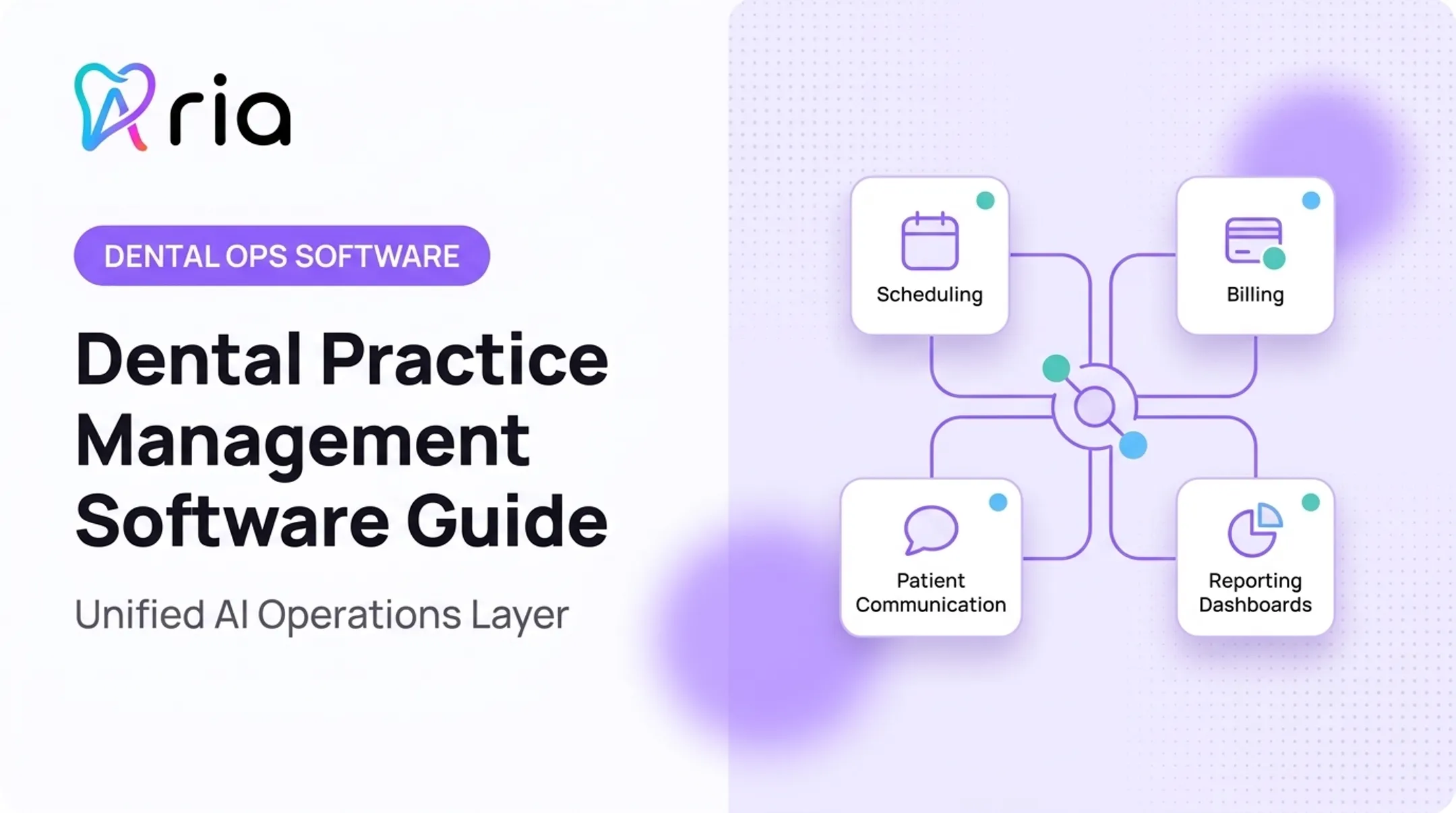
An AI operating layer like Aria sits on top of those systems. It pulls data from your PMS, billing software, payroll, and patient communications into one intelligent hub.
It does not replace your current stack. It makes those tools work together so you can ask questions in plain language, automate reports, and trigger workflows across platforms.
When evaluating any new technology, use this checklist:
- Integration: Connects cleanly with the systems you already run
- Data ownership: Lets you export your data without friction
- Security: Includes strong HIPAA safeguards and role-based access
- Reporting: Lets you customize the metrics that matter to your practice
- Implementation and support: Spells out training and ongoing help
- Total cost: Accounts for full cost of ownership, not only the subscription
An integrated layer can surface insights that stay buried in disconnected systems. With connected data, Aria can help you:
- Spot patients at high risk of no-showing
- Flag unscheduled treatment opportunities
- Alert the team to gaps in next week’s schedule
That kind of decision support helps staff act before problems hit the books. Practices using Aria have reported a 32% average reduction in administrative overhead and over 20 hours of manual admin time saved per week, though results vary by practice.
How Can Practices Maintain Compliance and Improve Continuously?
Compliance is a non-negotiable part of practice management. For U.S. dental practices, the core areas of focus include:
- HIPAA: Protecting patient health information.
- OSHA: Ensuring workplace safety, especially following the Bloodborne Pathogens Standard (29 CFR 1910.1030).
- Infection Prevention: Following CDC and state-level guidelines.
- State Dental Board Rules: Adhering to licensure and practice regulations in your specific state.
Given the complexity, seek professional legal or consulting guidance for practice-specific questions.
Build a recurring risk review into your calendar. On a set cadence, check:
- Access permissions across your systems
- Data backup verification
- Vendor agreements
- Staff training records
Those reviews only stick when management runs as a continuous improvement cycle, not a one-time cleanup. Don't change everything at once:
- Pick one bottleneck
- Test a single change
- Measure the result
- Standardize what works
Small improvements to people, processes, and technology compound into fewer compliance fire drills and a practice that can scale without constant rework.

Frequently Asked Questions
What is dental practice management?
Dental practice management is how a dental office runs its non-clinical operations. It coordinates people, workflows, finances, patient experience, technology, and compliance so the team can deliver high-quality care.
What is the average salary for a dental practice manager in the US?
According to Salary.com, the average U.S. Dental Practice Manager salary is about $132,767 per year as of late 2026. Pay varies by location, experience, practice size, and multi-location responsibility.
What is the difference between management and administration?
Administration covers routine tasks and processes, such as scheduling appointments or processing paperwork. Management goes further: planning, leading people, making strategic decisions, and tracking performance against practice goals.
What are the different types of management?
In a dental practice, management usually covers four areas: operations (daily workflows), finances (budgeting and revenue cycle), people (team leadership), and strategy (long-term growth and planning).
What is the best app for managing a dental clinic?
The "best" app depends entirely on your practice's specific needs. Instead of focusing on popularity, evaluate solutions based on their ability to handle your core workflows, integrate with your existing systems, provide actionable data, and scale with your growth plans.