Patients want two things: safety and a plan that fits their specific bite, budget, and life. Orthodontic teams want the same information they've always needed, just without digging for it across five different systems. AI can serve both goals, but only when it's treated as a tool that supports judgment rather than one that replaces it.
This article draws a clear line between clinical AI (imaging, diagnosis support, treatment modeling) and operational AI (scheduling, communication, reporting). Understanding that difference is the first step toward adopting either one responsibly.
Key Takeaways
- Clinicians remain accountable for every diagnosis and decision when AI supports imaging, planning, and monitoring.
- Studies show gains such as faster landmark detection, plus limits like inconsistent tooth-level alerts.
- Remote monitoring can reduce in-person visits without guaranteeing shorter overall treatment time.
- Keep operational AI (scheduling, recalls, reporting) separate from clinical AI to avoid patient and staff confusion.
- Responsible adoption starts with a small pilot, defined success metrics, and documented governance.
What AI in Orthodontics Means
AI in orthodontics is software that finds patterns in images or patient records, then turns those patterns into predictions, simulations, or automated tasks. It doesn't think the way a clinician does. It matches new inputs against patterns learned from prior data.
The American Dental Association separates true machine intelligence from "augmented intelligence," and places every care decision firmly with the clinician, not the software. That distinction matters because it shapes how practices should use these tools.
Most orthodontic AI falls into four practical buckets:
- Diagnostic AI – analyzes X-rays, cephalograms, and intraoral scans to identify landmarks or segment teeth
- Predictive AI – models potential tooth movement or supports decisions like extraction versus non-extraction
- Monitoring and engagement AI – reviews patient-submitted photos between visits and manages routine communication
- Operational AI – handles scheduling, reminders, reporting, and administrative workflows across a practice or group
Every output from these systems is a recommendation, not a ruling. The orthodontist still owns the diagnosis, the consent conversation, and the final treatment call.
How AI Is Used Across Orthodontic Care
AI shows up in ortho in two lanes: clinical tools that read images, plan tooth movement, and watch aligners between visits, and operational tools that handle outreach, scheduling, and reporting. The sections below separate those jobs so the limits stay clear.
Imaging and Scanning Support
Deep-learning models can locate cephalometric landmarks and segment teeth on intraoral scans faster than a human working alone. One study trained on more than 1,000 posteroanterior cephalograms found its model placed landmarks within 2mm of expert placement 67.5% of the time, with a mean radial error of 1.87mm (Lee et al., 2023). Condyle points were the weakest spot. The speed helps; a trained clinician still needs to check the tracing.

Separate intraoral scan research found tooth-segmentation accuracy above 89%, but with more errors clustered at tooth edges and on lingual incisor surfaces. Manual correction still matters.
Treatment Planning and Simulation
AI can compare a patient's scans against thousands of prior cases to model how teeth might move under different appliance choices.
- Extraction-decision models have hit mid-80s accuracy against experienced orthodontists' calls
- None of those studies validated the models against actual post-treatment outcomes
Treat the output as a second opinion to weigh, not a final call.
Appliance and Aligner Workflows
Digital bracket placement and customized appliance design increasingly rely on AI-assisted scan segmentation. Some published "digital setup" tools are actually rule-based ideal-arch algorithms rather than true AI, and a simulated tooth movement is not evidence the tooth will move exactly that way in the mouth. Clinicians still refine staging before anything goes to production.
Remote Monitoring Between Visits
Patients submit photos or scans; software flags possible aligner-tracking problems, hygiene concerns, or the need for a check-in. One prospective study found repeated scans agreed on the overall instruction (advance or hold) 83.3% of the time, but never fully agreed on which specific teeth were flagged. That gap is exactly why a person needs to review the alert before acting on it.
Patient Engagement and Operational Workflows
Beyond the chair, AI also runs reminders, answers routine questions, reactivates stalled consultations, and pulls reporting across providers or locations.
The line matters: an aligner-tracking flag is a clinical signal; a text about tomorrow's appointment is business automation. Aria, for example, works as an operational layer that connects a practice's existing systems for scheduling, recalls, and reporting. It does not make treatment decisions, and it is not meant to.
Benefits of AI for Orthodontic Patients and Practices
For Patients
- Clearer visualization of potential treatment outcomes before committing to a plan
- More personalized education based on their specific scans and history
- Earlier flags for possible issues between in-person visits
- Fewer unnecessary trips to the office when remote monitoring is clinically appropriate
A meta-analysis of controlled telemonitoring studies found an average of 2.75 fewer face-to-face visits per patient (95% CI: 1.55–3.95) (Torres et al., 2023).
The same analysis found no statistically significant difference in overall treatment duration. One smaller randomized trial actually found treatment ran 1.9 months longer despite fewer visits.
Fewer appointments don't automatically mean faster finish times.

For Practices
- Faster review of imaging and scan data
- More consistent follow-up on patients who might otherwise fall through the cracks
- Reduced repetitive administrative work
- Better coordination between clinical, front-office, and billing teams
Point Solutions vs. a Connected Layer
A single AI tool might handle one task well, say, flagging aligner non-tracking. But most practices run several disconnected tools that don't talk to each other.
A connected operational layer changes that. Teams can ask a question once and get an answer that spans locations, providers, or time periods. For multi-location dental groups, the gap between a point solution and a unified layer often shows up as hours saved per week rather than minutes.
Risks and Responsible Use of AI in Orthodontics
The Limits of Prediction
AI models reflect the data used to train them. Complex cases, unusual anatomy, or populations underrepresented in the training data can all produce shaky outputs. Image quality, missing records, and differences in how clinics document care all introduce their own noise.
Why Human Review Isn't Optional
A clinician still has to verify inputs, examine the patient directly, question a recommendation that doesn't fit, and document the actual decision made. A 2024 JADA ethics article specifically warns about bias and uneven performance across patient groups. It also flags the risk of overreliance on outputs that look confident but aren't always right.
Privacy and Security
Before adopting any AI tool that touches patient images or records, practices need to check:
- Data handling – where images and records are stored and processed
- Access controls and encryption – who can see what, and how it's protected
- Vendor agreements – whether a Business Associate Agreement is in place
- Retention practices – how long data is kept and how it's disposed of
HHS guidance is direct on this point: a cloud vendor handling protected health information is a business associate, encrypted or not, and needs a proper BAA plus a documented risk analysis.
Transparency and Trust
Patients deserve to know when AI contributed to their care plan, what it can and can't determine, and who to ask if they have questions. An automated message should never be the only path to a real conversation with the care team. The FDA's 2024 transparency principles for AI-enabled medical devices ask vendors to disclose intended use, known limitations, and underrepresented populations before deployment. Those same disclosures are useful questions for any practice evaluating a new tool.
How Orthodontic Practices Can Implement AI Responsibly
Start with a Workflow Audit
Before shopping for software, identify where the friction actually lives:
- Repetitive administrative tasks eating staff time
- Delayed follow-up on flagged patients
- Reporting gaps between locations or providers
- Bottlenecks in remote monitoring review
Pilot One Use Case
Pick one clearly defined starting point: appointment reminders, treatment-progress texts, or operational reporting. Before you flip the switch, lock in:
- Baseline metrics
- Success measure
- Owner for the workflow
- Escalation triggers
- Required patient consent
Build Governance Around It
Put guardrails in writing before the pilot spreads:
- Approved use cases only
- Scheduled review checkpoints
- Staff training on the workflow
- Performance checks across patient groups and locations
- A clear process to correct errors when they show up—because they will
Where a Connected Layer Fits
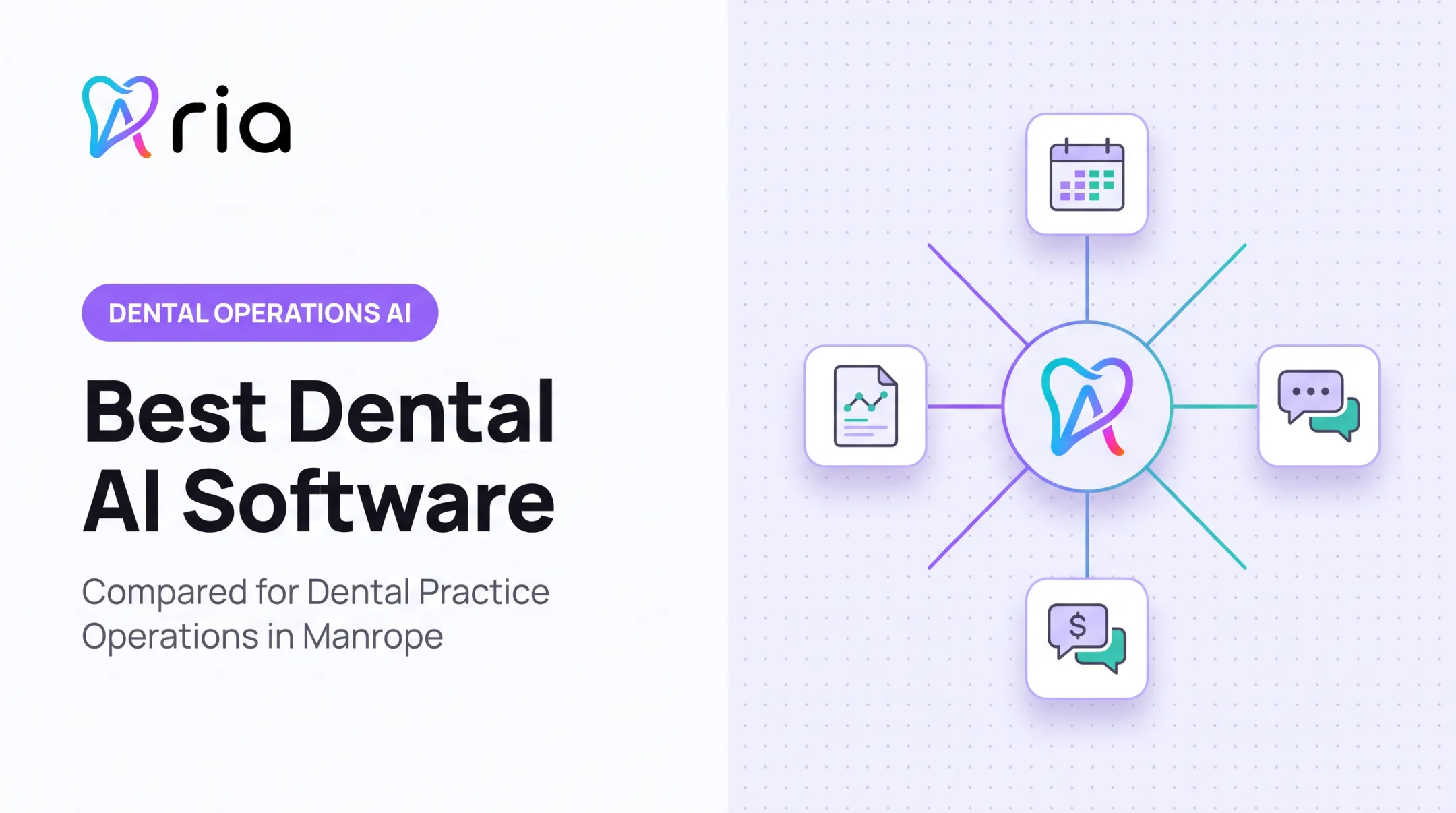
This is where a connected layer like Aria fits. It links practice management, revenue cycle, communications, payroll, procurement, and finance into one layer so teams can ask questions in plain language instead of exporting spreadsheets from five platforms.
A question like "which locations have the most unscheduled treatment this month?" can become a recurring report, a standing alert, or a patient outreach workflow—without touching diagnosis or treatment planning. The practice management system stays the system of record; Aria sits alongside it.
Scale Slowly
Before expanding a pilot, review patient experience, staff adoption, data quality, clinical safety, and the actual time required to keep the system running. If maintaining it costs more staff hours than it saves, it's not ready to scale.

Conclusion
AI in orthodontics works best as an assistant. It is strong at pattern recognition and useful for planning support, monitoring, and communication, but it should never be the one signing off on a diagnosis.
Published evidence backs this up: real speed gains in imaging, fewer visits in some workflows, and real gaps only a trained clinician can catch.
Practices that get this right tend to:
- Choose focused, explainable tools
- Keep clinicians and patients in control of decisions
- Tie every AI adoption to a measurable gain in care or workflow
If your team is buried in fragmented reporting across locations or providers, a unified operational layer can close that gap without ever touching a treatment plan.
Frequently Asked Questions
How is AI used in orthodontics?
AI supports diagnostic imaging, treatment simulations, aligner and appliance planning, remote monitoring, and patient communication. Orthodontists retain full responsibility for diagnosis and treatment decisions.
Can AI replace an orthodontist?
No. AI can analyze data and generate predictions, but it can't replace a clinical exam, professional judgment, informed consent, or the responsibility that comes with treating a real patient.
How does AI help with orthodontic treatment planning?
AI can analyze scans and records, model potential tooth movement, and compare treatment scenarios to create patient-friendly visualizations. Every output still requires clinician review before it becomes a plan.
Is AI in orthodontics safe?
Safety depends on validated use, data quality, privacy protections, and whether clinicians actually verify outputs instead of accepting them automatically. No tool is safe by default just because it's labeled "AI."
How does AI remote monitoring work in orthodontics?
Patients submit photos or scans between visits, and software flags possible tracking issues or concerns. The orthodontic team then decides whether the situation needs reassurance, new instructions, or an in-person visit.
How should an orthodontic practice start using AI?
Start with a workflow audit, run one measurable pilot, train staff, document governance, and review privacy protections before expanding. Scale only after checking real results against your original baseline.