](https://file-host.link/website/ariaforops-k0xzep/assets/blog-images/e5d60340-3b1a-4d91-92a9-d5879c053d7f/1791576958033665_79915684e4a642bb9f52a8fa1310b410/2x_360.webp)
Introduction
Walk into most US dental practices on a Monday morning and you'll see the same scene. Front-desk staff juggle patient calls, a scheduling gap sits empty because nobody caught it in time, and a treatment coordinator still chases last week's unscheduled crown case in a spreadsheet.
Administrative work in dentistry isn't a side issue. The 2025 CAQH Index estimates $6.6 billion in annual US dental administrative-transaction spending, with CAQH's industry report pointing to $1.9 billion in remaining savings if more of that work moved to electronic processes.
AI healthcare technology for dental practices covers far more than diagnostic imaging software. It can support clinical workflows, cut repetitive admin tasks, and give practice leaders a clearer read on operations before small problems become expensive ones.
This guide breaks down where that technology fits day to day, what it can automate, and how dental teams use it alongside the systems they already run.
Key Takeaways
- Dental AI spans four distinct functions: clinical decision support, predictive analytics, generative AI, and workflow automation
- High-value use cases include patient reactivation, treatment-plan follow-up, schedule optimization, and revenue-cycle reporting
- AI should augment staff judgment and patient relationships, never replace them outright
- Evaluate any platform on integration depth, data security, transparency, and measurable outcomes before buying
- A connected intelligence layer can turn scattered data into daily action, not just another dashboard
What AI Healthcare Technology Means for Dental Practices
AI healthcare technology is software that identifies patterns, generates content, predicts likely events, and recommends or executes workflow actions based on connected data. In a dental office, that might mean flagging a patient who hasn't booked their crown, drafting a recall text, or forecasting next month's collections.
Not all dental AI does the same job. The main categories look like this:
| Category | What it does | Dental example |
|---|---|---|
| Clinical decision support & imaging | Assists with review and documentation | Flagging areas of a radiograph for a dentist's review, not autonomous diagnosis |
| Predictive analytics | Forecasts outcomes from historical data | Identifying no-show risk, patient churn, or schedule gaps |
| Generative AI | Drafts text in response to prompts | Writing recall messages, claims-appeal drafts, or performance summaries |
| Workflow automation | Executes approved, repeatable tasks | Syncing billing data, triggering outreach sequences |
Clinical Tools Stay in Their Lane
Imaging and decision-support AI can highlight findings worth a second look, but it shouldn't be marketed or treated as an autonomous diagnostician. The dentist still reads the film and makes the call.
Clinical imaging is only part of the picture. The AI most practices feel day to day runs through operations, outreach, and the front desk.
Chatbot vs. Dental-Business AI
There's a meaningful gap between a consumer chatbot and a practice-grade platform. A general-purpose tool like ChatGPT generates plausible text from public training data. A dental operating platform works differently:
- Pulls from authorized, practice-specific business data
- Operates under defined staff permissions
- Logs actions for auditability
- Routes decisions through workflow controls, not guesswork
That distinction matters more than most vendors admit, especially once patient data and billing are involved.
How Dental Practices Can Use AI
Map dental AI to workflow, not technology category: what the AI does, which team member benefits, and where a human stays accountable.
Patient Engagement and Treatment Acceptance
Unscheduled treatment plans quietly drain revenue. AI can:
- Identify overdue or inactive patients from recall data
- Prioritize unscheduled treatment plans by dollar value
- Draft personalized outreach for staff approval
- Support SMS, voice, web chat, and social communication
Aria's platform, for instance, can surface a list like seven patients representing $26,200 in unscheduled treatment alongside 20 patients due for recall, then recommend outreach priorities for the day. A treatment coordinator still makes the call, but they're not digging through reports to find the opportunity first.
Scheduling and No-Show Reduction
Predictive models can flag which appointments are most likely to be missed, so staff focus outreach where it matters instead of blanket reminders.
A 2022 randomized study at Kaiser Permanente Washington tested this directly. Adding a second text reminder for visits flagged as high-risk reduced no-show risk by 7% for primary-care visits and 11% for mental-health visits, relative to a single reminder, according to the Permanente Journal study.

That trial wasn't dental and measured relative risk, not raw percentage points. It still shows the core mechanic: targeted outreach beats one-size-fits-all reminders.
Revenue-Cycle and Financial Operations
Billing, claims, and collections are where admin hours disappear fastest. AI-supported platforms can bring together:
- Production and collections tracking against daily or monthly goals
- Claims and billing workflow status
- Automated alerts when collections fall short
- Recurring reports instead of manual spreadsheet pulls
The American Hospital Association describes AI flagging claims likely to be denied, based on payment history and payer rules, as an emerging revenue-cycle application, per AHA's 2024 report.
Dental-specific benchmarks for collections impact are thinner, so treat vendor percentage claims with some skepticism until you've tested them against your own numbers.
Workforce, Procurement, and Multi-Location Comparisons
For groups running more than one location, AI can compare providers, time periods, or practices side by side, surfacing labor-efficiency issues, hygiene performance gaps, or supply needs that a single office manager would otherwise miss.
A Connected Intelligence Layer in Practice
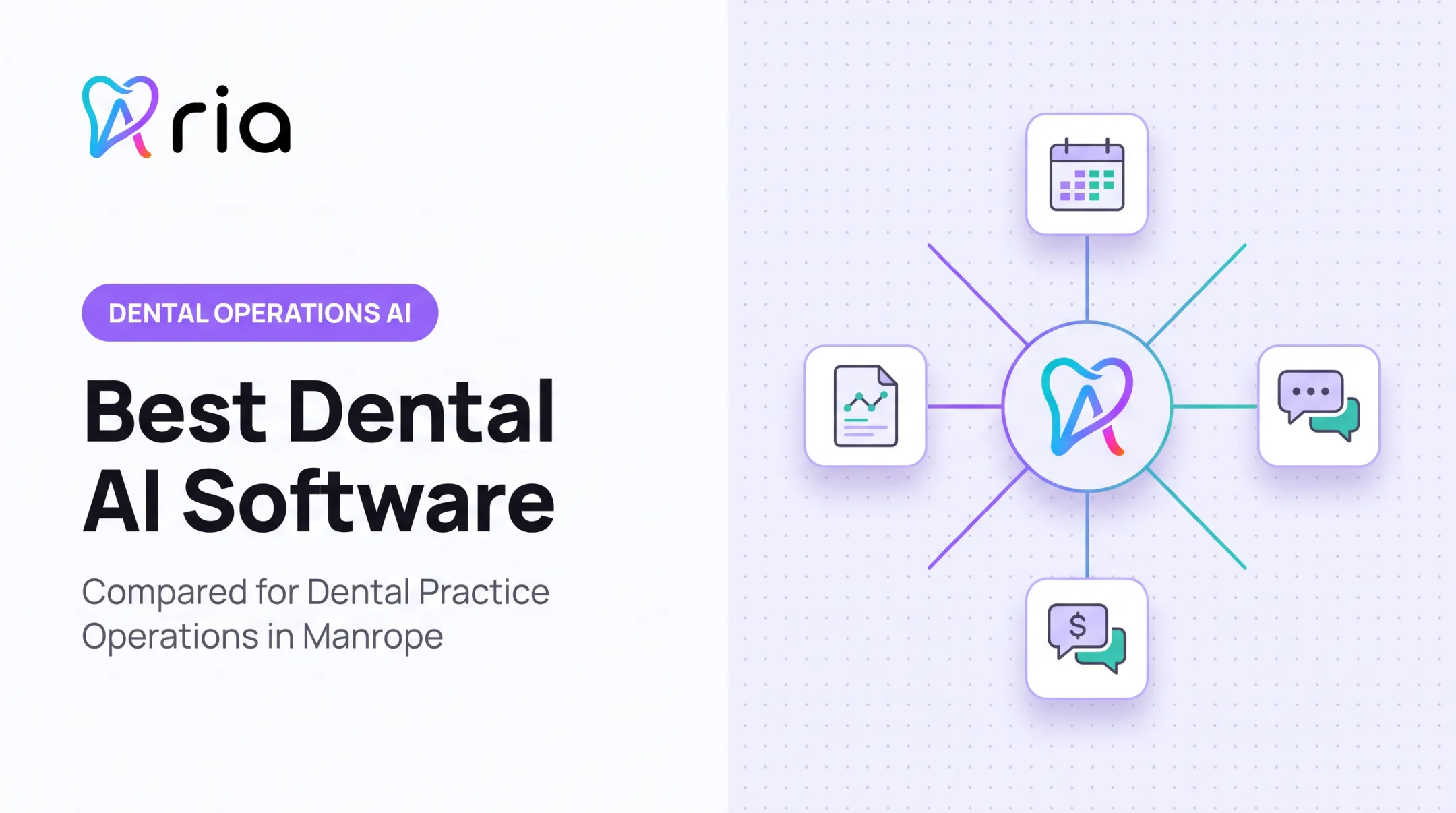
This is where a platform like Aria fits. Instead of five logins and five exports, dental teams ask a plain-language question—"How did hygiene production compare across locations last month?"—and get an answer pulled from practice-management, revenue-cycle, payroll, and finance systems at once.
Approved answers can become recurring reports, standing alerts, or automated patient outreach, without replacing the practice-management system underneath.
The Benefits of AI for Dental Practices
Less Administrative Drag
Repetitive querying, reporting, and follow-up eat staff hours that could go toward patients. Aria reports an average 32% reduction in administrative overhead and 20+ hours of manual work saved per week after implementation. These are company-attributed figures from Aria's own customer data, not an independent industry benchmark, but they reflect the kind of time recovery practices should expect to measure for themselves.
Faster Visibility Into Performance
Unified data means a practice owner can see production, collections, labor efficiency, hygiene, and forecasts without assembling a single spreadsheet. One illustrative Aria demo pulled production, schedule, accounts receivable, and labor cost data from three separate systems and returned an analysis in 2.1 seconds.

A Better Patient Experience, Without Losing the Human Touch
Faster responses and consistent follow-up improve continuity. But sensitive conversations, such as treatment discussions and financial hardship calls, still need a trained team member. AI should shorten the wait, not replace the relationship.
More Consistent Operations Across Practice Types
Whether it's a solo owner-dentist office, a growing multi-location group, or a newly acquired practice, a shared intelligence layer helps standardize workflows instead of relying on whatever system each office happened to inherit.
The Trade-offs Worth Knowing
AI isn't a cure-all. Watch for:
- Poor data quality undermining predictions
- Fragmented integrations that create new manual work
- False positives and alert fatigue wearing down staff trust
- Overreliance on automated recommendations without review
The Agency for Healthcare Research and Quality notes that AI models inherit the limitations of their training data, and that poor workflow design can cause exactly this kind of alert fatigue and mistrust. Governance isn't optional; it's what makes the rest of this work.
How to Implement AI Responsibly in a Dental Practice
Rolling out AI well takes more than picking a vendor with a long features list. Follow a structured approach:
Audit workflows and data first. Identify your highest-cost repetitive tasks, document where that information currently lives, and name the staff member responsible for each process. Pick one or two measurable pilot goals before you buy anything.
Evaluate integration and data controls. Ask vendors directly: Which practice-management, revenue-cycle, payroll, and communications systems do you support? How is data synchronized? Who controls permissions, and how are access and audit logs handled?
Set human oversight boundaries. Require a qualified team member to review patient-facing messages and operational recommendations. Prohibit unreviewed diagnostic or treatment decisions outright, and define escalation rules for anything unusual.
Validate before scaling. Compare baseline staff time, response speed, schedule utilization, and reactivation rates with post-launch results. If the tool uses protected health information, HHS may treat the vendor as a HIPAA business associate, so HHS's guidance on written assurances and safeguards applies, not a self-reported "HIPAA compliant" label.
Prepare your team. Role-specific training, written usage policies, and regular review of false alerts matter more than the software itself. A platform like Aria fits practices looking for one operating layer across connected systems, but that doesn't mean every practice needs an identical rollout.
Compare vendors on substance, not feature counts. Look at integration depth, workflow actions, explainability, support quality, and actual evidence of outcomes.

Frequently Asked Questions
What is the best AI tool for healthcare?
It depends on your use case, data environment, and privacy requirements. For dental practices, compare narrow clinical tools against operational platforms that connect your existing systems and support human oversight.
Can ChatGPT help with medical diagnosis?
No. General-purpose ChatGPT should never replace a licensed dentist's examination or diagnosis. The American Medical Association warns it can produce convincing but false answers, though it may assist with approved drafting tasks under proper safeguards.
Is there a medical AI like ChatGPT?
Yes, but healthcare-specific systems are built differently. They are trained, integrated, and governed for defined clinical or administrative workflows, unlike general-purpose conversational AI built for broad public use.
What kind of AI is used in healthcare?
Machine learning, predictive analytics, generative AI, natural language processing, computer vision, and workflow automation all appear in healthcare settings. In dentistry, examples include no-show prediction, recall messaging, and automated claims checks.
What are the top AI applications in healthcare?
Common applications include imaging support, documentation, patient communication, predictive risk identification, scheduling, billing, and reporting. For dental practices specifically, patient reactivation, schedule optimization, and revenue-cycle reporting tend to deliver the fastest returns.