Dental schedules are already tight. Dentists reported their schedules averaged 84% full in October 2023, and 80-81% cited no-shows or late cancellations as the main reason they weren't fuller, according to ADA's Health Policy Institute. That gap between a full schedule and an actually productive one is where agent automation lives.
Agent automation refers to software that can interpret a business goal, pull context from connected systems, choose and sequence the right actions, complete the work, and escalate to a human when something looks off. This article covers how dental AI agents actually work, how they differ from chatbots and traditional automation, where they fit in day-to-day operations, and the safeguards a practice should expect before handing over any task.
Key Takeaways
- An AI agent pursues a defined goal across multiple steps and tools, unlike a chatbot or a fixed scheduled workflow.
- Dental agent automation fits administrative, operational, and revenue-cycle tasks, not clinical diagnosis or treatment decisions.
- Task predictability, risk level, data access, and required human review determine which approach makes sense.
- Strong implementations pair agent capabilities with rules, existing systems, staff oversight, and clear permissions.
What Does Agent Automation Mean for a Dental Practice?
In practical terms, an AI agent receives a goal and works a continuous loop. It observes relevant information, reasons about the situation, picks an action, and uses connected tools to carry it out. Then it checks the result and either keeps going or flags a person. That loop is what separates it from a static workflow.
A traditional "if this, then that" automation fires the same response every time a trigger occurs. An agent instead weighs context before acting. Take recovering unscheduled treatment: a fixed workflow might blast the same reminder text to everyone on a list. An agent, by contrast, could:
- Identify which unaccepted treatment plans meet the practice's follow-up criteria
- Prioritize which patients to contact first based on dollar value, time since diagnosis, or appointment history
- Select the approved channel (text, email, or call) for each patient
- Document the outreach attempt in the system of record
- Route any patient reply to the right staff member
That kind of prioritization is what Aria's Morning Huddle report delivers in practice. One documented example surfaced 7 patients with unscheduled treatment worth $26,200 in a single morning view, giving staff a prioritized starting point instead of a blank search.
Tools, Integrations, and Boundaries
Agents only work as well as the systems they can reach. That typically means connections to the practice management system, patient communication platforms, revenue-cycle data, scheduling, payroll, and finance or procurement applications.
Autonomy has limits, too. An agent might recommend, draft, communicate, update records, or create tasks on its own. Sensitive or high-impact actions, such as altering a treatment plan or sending certain financial communications, should require human sign-off.
A simple test cuts through the marketing noise around the word "agent." Can the system work toward a goal, choose among actions, use tools, respond to outcomes, and stay inside defined guardrails? If not, it's something else, however it's labeled.
How Does Agent Automation Work in a Dental Practice?
Underneath the marketing language, most agent systems follow a similar loop: perceive information, interpret context, plan or prioritize, execute approved actions, then evaluate the outcome before repeating. Google describes this as reasoning through steps, synthesizing information, acting through connected tools, and retaining what happened for next time, according to Google Cloud's guide.

For a dental practice, decisions should be grounded in current practice data and business rules, not just a general-purpose language model's training. Asking "how are we tracking against production, collections, hygiene, and new-patient goals this month?" only produces a useful answer if the system is actually reading the connected PMS, revenue-cycle, and accounting data behind the question.
What Triggers the Work
Agent workflows don't wait to be asked. Events can start the process automatically:
- A cancelled appointment
- An overdue hygiene recall or follow-up
- A newly opened schedule gap
- A patient's text or email reply
- An unresolved task from a prior workflow
- A metric, like daily production, falling behind goal
The system also needs memory: what it already checked, which outreach went out, what response came back, and what's left to do. Without that state tracking, an agent re-contacts the same patient twice or drops a thread entirely.
Human-in-the-Loop Controls
None of this should run unchecked. Practical controls include:
- Approval queues and escalation rules
- Confidence thresholds before action
- Role-based permissions
- Activity logs for auditability
- Pause or override options mid-run
A quick example: Aria's Morning Huddle refreshes each morning and might flag a 30-minute opening at 11:30 AM. Surfacing that gap and suggesting "fill the emergency slot" is largely rule-based reporting. Recommending which patient to contact leans on predictive prioritization. Actually sending the message and booking the patient should stay in a staff review queue, since it affects a real appointment.
How Is Agent Automation Different From Other AI and Automation Tools?
The terms get used loosely, which causes confusion when practices are evaluating software. Here's how the categories actually differ:
| Category | How it decides | Can it act across systems? | Adapts to new conditions? |
|---|---|---|---|
| Traditional automation | Preset rule, same output every time | Limited, usually one system | No |
| RPA | Scripted steps mimicking manual clicks | Yes, within scripted scope | No |
| Chatbot | Pattern-matches a question to a response | Rarely | No |
| LLM | Generates or interprets text from training | Not on its own | Partially, within a conversation |
| AI agent | Plans, prioritizes, and selects among actions | Yes, through tools | Yes |
IBM draws a similar line. Traditional automation handles repetitive, rule-based tasks. Agents can orchestrate processes across systems and adjust decisions instead of following rigid logic, according to IBM's enterprise AI analysis.
An LLM is a language model. An agent is a broader system that might use an LLM alongside memory, tools, rules, and execution controls. ChatGPT, for most uses, is an LLM-powered conversational app. Whether a specific implementation counts as agentic depends on whether it can pursue goals, call tools, and take actions across steps.
Dental examples, mapped:
- A reminder template sent on a fixed schedule: traditional automation
- A web chat answering office-hours questions: chatbot
- A natural-language report builder pulling production numbers: LLM-assisted
- A system that spots an unscheduled-treatment opportunity and executes approved follow-up: agent automation
Don't default to the most autonomous option, though. Predictable, high-volume, low-variance tasks, like sending appointment confirmations, are often faster and safer handled by straightforward rules. Save agent automation for workflows with real variability and cross-system decisions.
What Can Agent Automation Do for Dental Practices?
The strongest opportunities share a pattern: repetitive, cross-system, context-dependent work where staff currently gather information, judge what matters, and chase several follow-up steps by hand.
Unscheduled Treatment and Patient Reactivation
An agent can identify unaccepted or unfinished treatment that meets a practice's follow-up criteria, segment patients by approved rules, recommend next steps, draft or send approved outreach, and log the outcome. Predictive signals can help prioritize patients at risk of no-showing or going inactive, though sensitive communications still need staff-defined rules and review.
Scheduling and Front-Office Operations
This covers schedule-gap monitoring, appointment confirmations, cancellation follow-up, waitlist coordination, and routing patient questions to the right person. Not every action should run unattended, though. Filling a routine confirmation is low-risk; rebooking a cancelled slot affects a patient's expectations and should typically require a confirmation step.
Revenue Cycle and Operational Intelligence
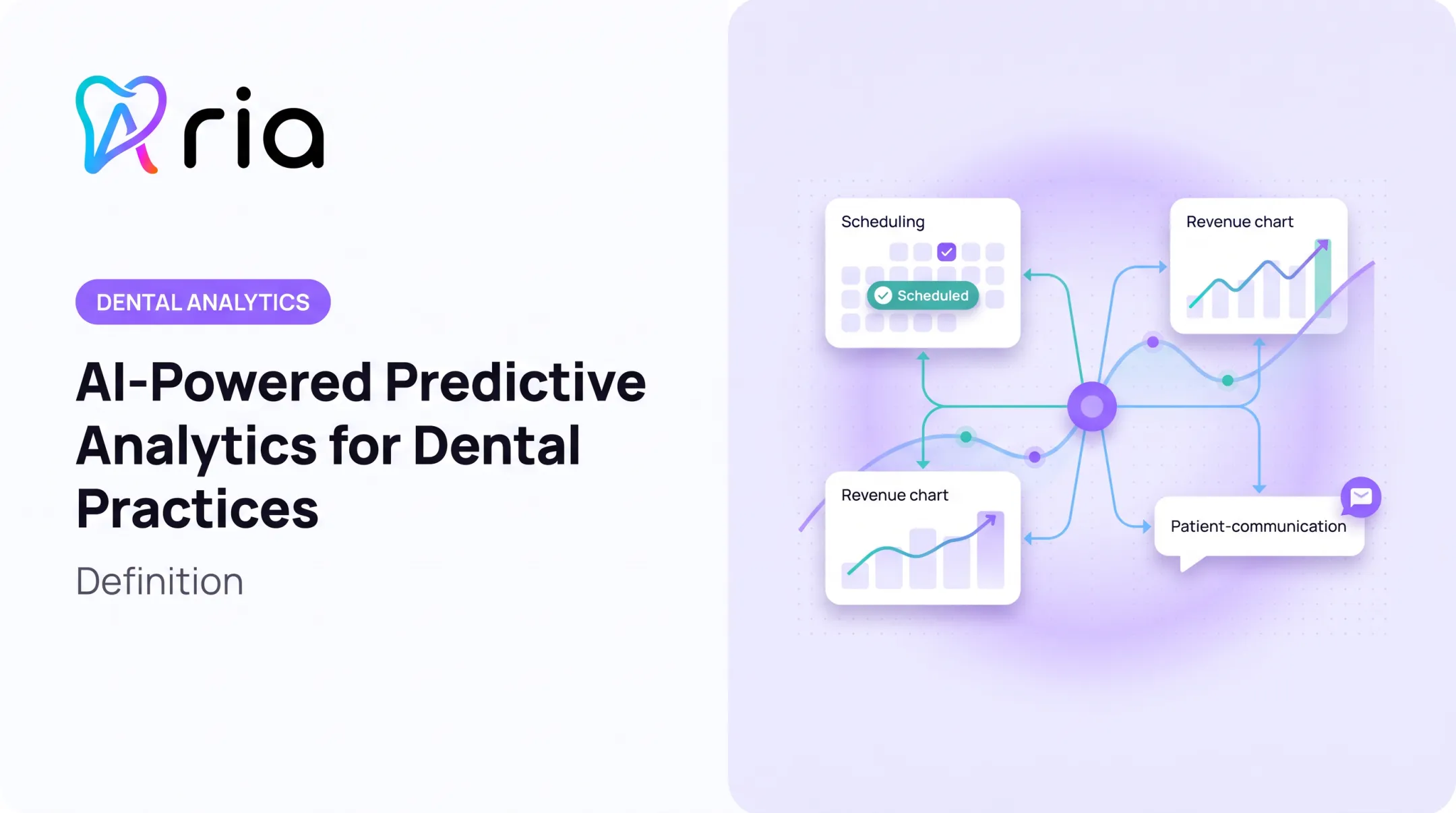
Agents can pull from production, collections, claims, payments, labor, and hygiene data to answer questions, spot anomalies, and build recurring reports. The difference from a dashboard: instead of displaying numbers for someone to interpret, the agent turns an insight directly into a task, alert, or escalation.
Multi-Location and DSO Coordination
A shared intelligence layer lets groups compare locations, providers, and periods without someone manually assembling spreadsheets from five different offices. Groups can standardize common workflows and permissions while still letting individual practices keep approved local processes.
Aria as an Example of a Dental AI Operating Layer
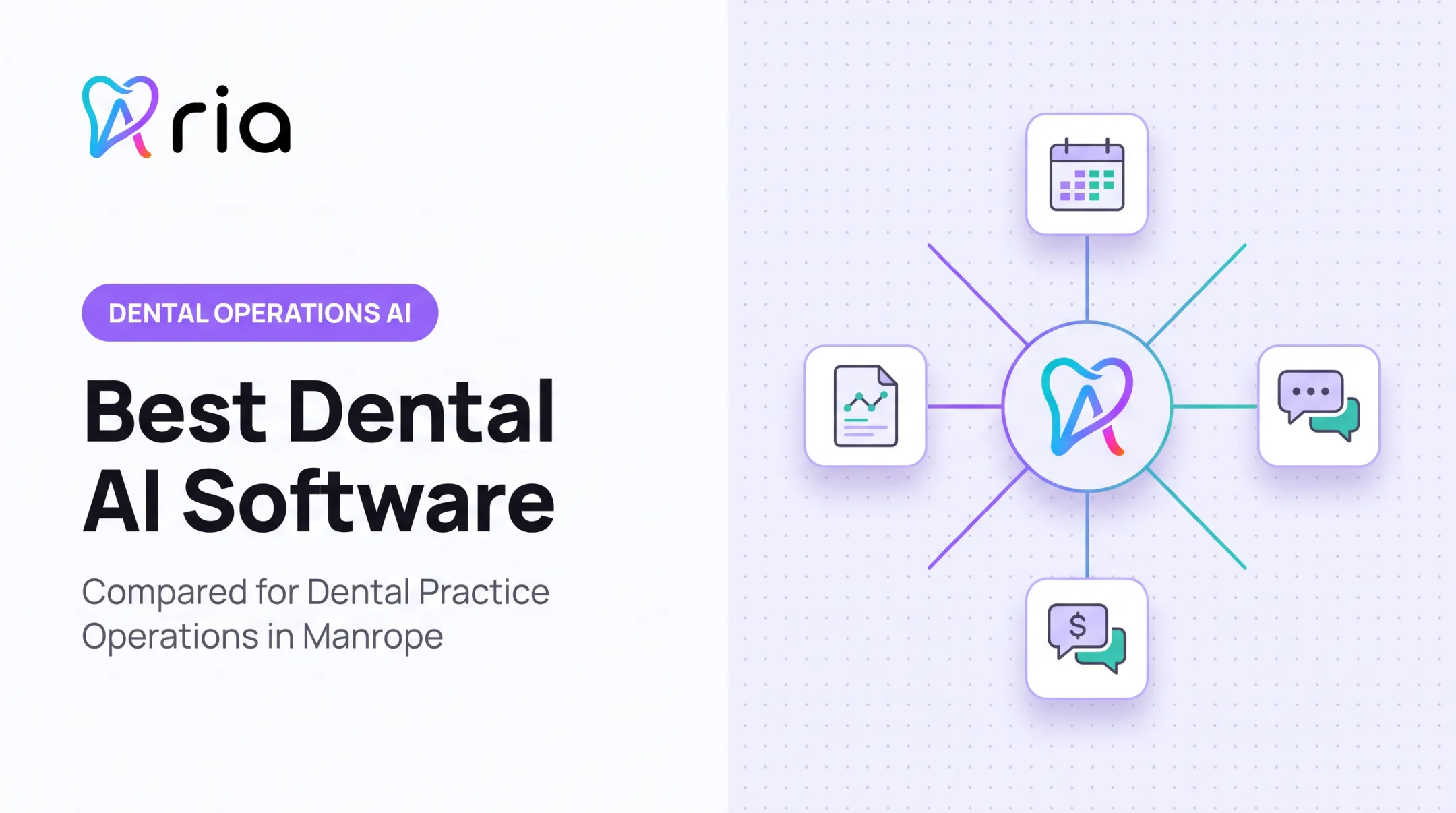
Aria connects practice-management, revenue-cycle, payroll, patient-communications, procurement, and finance systems so a team can query information and start work from one place. Its documented capabilities include natural-language operational questions, recurring reports, alerts, patient outreach, and predictive identification of schedule gaps and patient opportunities. Not every workflow runs fully autonomously; many are designed with staff review built in.
Aria reports an average 32% reduction in administrative overhead and more than 20 hours saved per week in manual administrative time after implementation, according to the company's own measurement data.

What Are the Benefits and Limitations of Agent Automation?
Potential benefits include:
- Less repetitive administrative work for front-office and billing staff
- Faster access to operational answers without building a report from scratch
- Earlier identification of schedule or revenue opportunities
- More consistent patient follow-up
- Better coordination across otherwise disconnected systems
Staff experience shifts accordingly. When an agent handles information-gathering and routine execution, front-office and billing teams can spend more time on patient service and the exceptions that actually need a human.
Limitations are real, too:
- Incomplete or inconsistent source data leads to bad prioritization
- Integration failures can break workflows silently
- Ambiguous patient messages can confuse any system
- Model errors, latency, implementation cost, and ongoing monitoring mean this is not an install-and-forget tool
Privacy and Security Expectations
Systems touching patient and business data should meet baseline safeguards:
- Least-privilege access and role-based permissions
- Encryption where appropriate
- Audit trails and retention controls
- Vendor security review
- Documented escalation procedures
HHS's Security Rule calls for role-appropriate access policies and mechanisms to track activity in any system holding electronic health information, according to HHS's Security Rule. Encryption is labeled "addressable" under HIPAA, which does not mean optional; it means a practice has to assess the risk and document its approach.
An agent should never make unsupported clinical judgments, alter treatment decisions, send inappropriate patient communications, or take irreversible financial or scheduling actions without a human check first.
How Should a Dental Practice Start With Agent Automation?
Start with one measurable workflow, not a platform-wide rollout. Pick something with clear inputs, a defined outcome, manageable risk, and decent data quality behind it.
Before choosing a solution, work through a quick checklist:
- Map the manual steps currently involved and which systems they touch
- Identify decision points and exceptions that come up regularly
- List who owns each step and what permissions they currently have
- Set a baseline for how the task performs today
- Define success measures before the pilot starts, not after
From there, map autonomy levels deliberately:
- Fully automated: low-risk, repetitive actions like generating a recurring report
- Approval-required: anything touching patient communication or finances
- Recommendation-only: ambiguous or high-impact decisions that still need a person
Build the pilot with guardrails from day one:
- Run on test data or a controlled rollout
- Train staff and define a clear exception-handling path
- Keep action logs and a checkpoint to revise or stop if the workflow underperforms
Measure results against your own baseline, not borrowed benchmarks:
- Administrative hours saved
- Follow-up completion rates
- Appointment utilization
- Escalation rates

Judge any solution on integration breadth and governance, not conversation quality alone. Agent automation creates value through reliable action across connected systems.
Frequently Asked Questions
What is an agent in automation?
An agent is software that perceives relevant information, pursues a defined goal, selects and executes actions through connected tools, evaluates the results, and adapts or escalates within approved boundaries. It's distinguished by this goal-directed, multi-step behavior.
Is ChatGPT an agent or LLM?
ChatGPT is powered by an LLM and functions primarily as a conversational application. An implementation only qualifies as agentic when it adds goal-directed planning, tool use, memory, and the ability to take external actions.
What are the 7 types of AI agents?
Commonly discussed categories include simple reflex, model-based, goal-based, utility-based, learning, planning, and conversational or collaborative agents. Classifications vary by source, and not every system fits neatly into one bucket.
How is agent automation different from traditional dental practice automation?
Traditional automation follows fixed, rule-based steps that repeat the same way every time. Agent automation interprets context, chooses among approved actions, coordinates multiple systems, and adjusts its response as conditions change.
What can an AI agent automate in a dental practice?
Common uses include administrative reporting, patient outreach, unscheduled treatment follow-up, scheduling support, no-show or churn-risk prioritization, revenue-cycle tasks, alerts, and cross-location coordination. Human oversight still matters for sensitive or high-impact actions.